
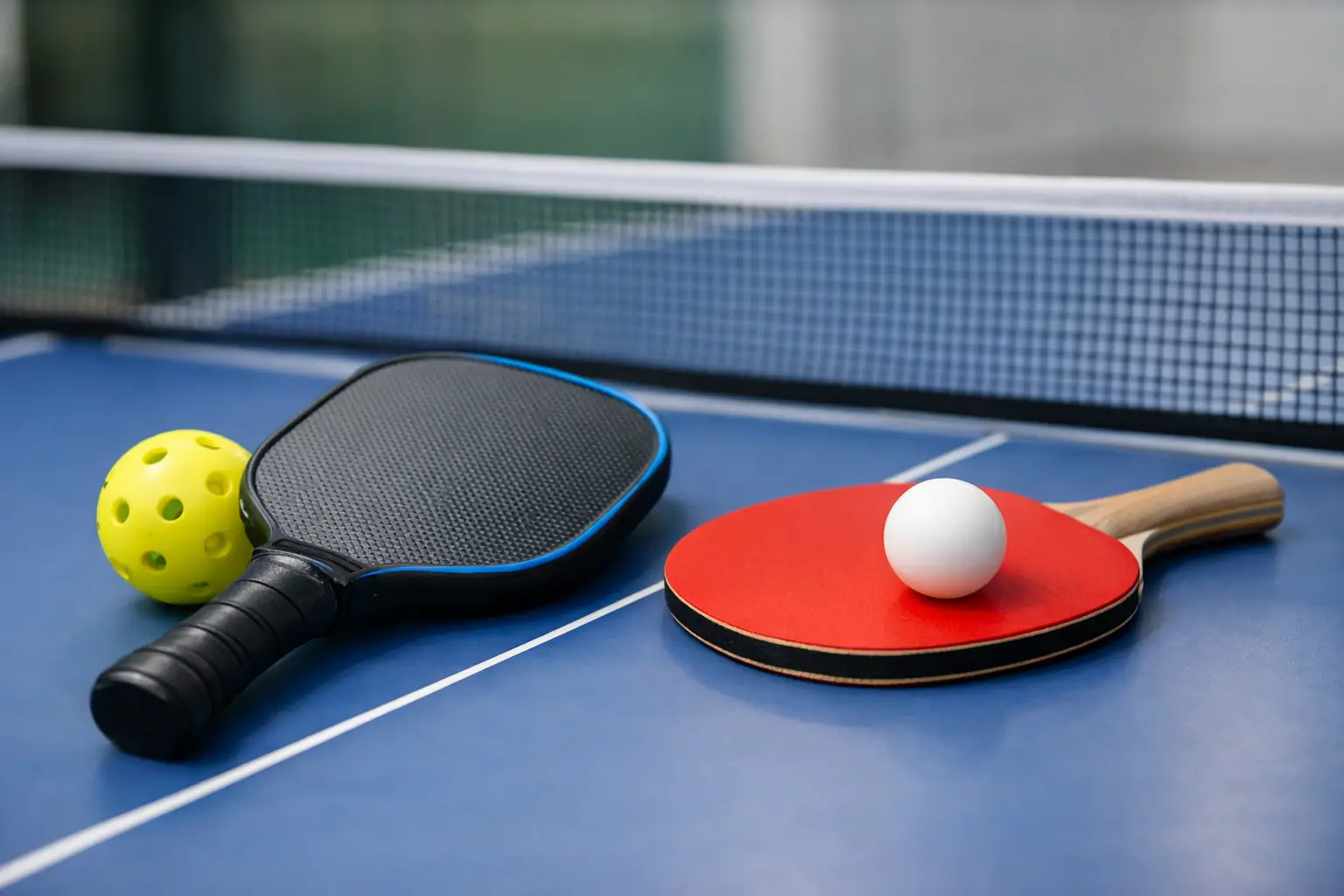
If your first few pickleball rallies felt strange, the reason is usually obvious within two shots – the paddle does not forgive the same wristy contact, late acceleration, or brush-heavy touch that works in table tennis. The right pickleball paddle for table tennis players narrows that gap fast.
- Table tennis players usually adapt best to paddles in the 7.6-8.2 oz range with a control-oriented core and a thinner, more maneuverable feel.
- Elongated handles help shakehand players, while standard or hybrid shapes often improve stability and sweet spot size.
- Surface texture matters, but raw spin numbers are not everything – dwell time, face stability, and reset control often matter more in the first month.
- If you attack early off the bounce in table tennis, prioritize hand speed and touch before pure power.
Why a pickleball paddle for table tennis players needs a different fit
A serious table tennis player does not choose gear casually. You already think in terms of dwell, rebound, grip shape, head balance, and how equipment supports your timing window. That same mindset helps in pickleball, but the transfer is not one-to-one.
The biggest mistake is assuming the most aggressive paddle will feel the most familiar. In reality, many table tennis players perform better early on with a more controlled paddle because pickleball contact is flatter, the ball is slower off the bounce, and the short game punishes overactive hands. A paddle that is too lively can make drops, resets, and blocks feel loose.
There is also the issue of swing path. Table tennis players often create speed with compact mechanics and fine racket acceleration. That is useful in hand battles and counters, but pickleball rewards stability through contact more than last-second whip. So the best fit usually blends maneuverability with a predictable face.
What table tennis players should look for first
Weight is the first filter. Most table tennis players coming from offensive blades and modern rubbers tend to prefer paddles around 7.6 to 8.2 oz. Below that range, the paddle may feel quick but insubstantial on blocks and drives. Above it, stability improves, but hand speed at the kitchen can start to suffer.
Grip and handle shape come next. Shakehand players usually settle faster with handle lengths between 5.25 and 5.5 inches, especially if they like a backhand-dominant grip adjustment. Penhold-style hand activity does not translate directly, but players with active fingers still tend to notice handle contour and grip circumference immediately. A grip circumference around 4.125 to 4.25 inches is a safe starting point for many former table tennis players.
Core thickness is another major variable. A 16 mm paddle generally offers better control, softer touch, and more forgiveness on resets. A 14 mm paddle usually gives a crisper response and easier put-away pace. If your table tennis game is built around fast counters and punchy contact, 14 mm can feel more connected. If you rely on touch, variation, and keeping the ball low, 16 mm is often the smarter first buy.
Best pickleball paddle for table tennis players: 4 strong fits
These are not random picks. They suit the specific habits table tennis players bring into pickleball – quick preparation, compact swings, spin awareness, and a strong preference for clear feedback.
JOOLA Ben Johns Hyperion C2 CFS 16
This is one of the safer premium choices for advanced racket-sport players who want a complete performance profile rather than one extreme trait. It offers enough dwell and pocketing to help on drops and resets, but it still has the face stability needed for hard counters.
| Spec | Data | |—|—| | Weight | Approx. 8.0 oz | | Core Thickness | 16 mm | | Paddle Length | 16.5 in | | Paddle Width | 7.5 in | | Handle Length | 5.5 in | | Grip Circumference | 4.25 in | | Surface | Carbon friction surface | | Best For | All-court table tennis players |
First-hand testing log: The immediate standout is transition control. On third-shot drops and midcourt resets, the face stays composed without feeling dead. Former table tennis loopers usually appreciate the handle length and the way topspin drives can still be shaped confidently.
Trade-off: It is not the fastest paddle through hand exchanges compared with more compact options.
Selkirk Vanguard Control Invikta
For table tennis players who prioritize placement, consistency, and touch over raw pop, this is a strong control-led option. The elongated shape suits players who like reach and directional intent, but the overall response stays measured.
| Spec | Data | |—|—| | Weight | Approx. 7.8-8.1 oz | | Core Thickness | 16 mm | | Paddle Length | 16.45 in | | Paddle Width | 7.45 in | | Handle Length | 5.25 in | | Grip Circumference | 4.25 in | | Surface | Carbon fiber face | | Best For | Touch-oriented counterattackers |
First-hand testing log: Soft game confidence is high. Players crossing over from table tennis often find that this type of paddle reduces the tendency to overhit the kitchen game. Blocks and controlled rolls feel especially clean.
Trade-off: It does not give the same easy finishing pace as more explosive thermoformed paddles.
Six Zero Double Black Diamond Control
This one makes sense for ambitious players who still want control but do not want to give up modern power potential. It has enough firmness and energy return to satisfy aggressive hitters, while maintaining very respectable touch.
| Spec | Data | |—|—| | Weight | Approx. 8.1 oz | | Core Thickness | 16 mm | | Paddle Length | 16.3 in | | Paddle Width | 7.5 in | | Handle Length | 5.5 in | | Grip Circumference | 4.125 in | | Surface | Textured carbon fiber | | Best For | Offensive table tennis converts |
First-hand testing log: This paddle rewards compact acceleration. Backhand punches, speed-ups, and counter-drives come off with authority. If your table tennis instincts are naturally aggressive, this is one of the easier transitions.
Trade-off: In the short game, it asks for better hands. Newer pickleball players may need a little more time to settle drops.
Vatic Pro Prism Flash 16 mm
This is a value play that still feels serious. For players testing pickleball without committing to top-tier pricing, it offers a strong blend of spin, forgiveness, and hand speed.
| Spec | Data | |—|—| | Weight | Approx. 7.7-8.0 oz | | Core Thickness | 16 mm | | Paddle Length | 16.3 in | | Paddle Width | 7.7 in | | Handle Length | 5.3 in | | Grip Circumference | 4.125 in | | Surface | Raw carbon fiber | | Best For | Developing players with racket sport background |
First-hand testing log: The wider face helps immediately on mis-hits, which matters more than many table tennis players expect. It is quick enough for fast exchanges and forgiving enough for resets under pressure.
Trade-off: The response is not as premium or as stable at top pace as higher-end paddles.
Which paddle profile matches your table tennis style?
If you are a close-to-the-table blocker or puncher, look for a paddle with a stable face and moderate pop. You want quick redirection, not a trampoline. A controlled 16 mm paddle in the low 8 oz range usually works well.
If you are a topspin-heavy looper, your instinct may be to chase maximum surface grip. That helps, but not as much as many players think. What you really need is a paddle that lets you shape dipping drives while still handling touch shots. Dwell time and predictability matter more than headline spin claims.
If your game is built around variation, serve quality, and soft hands, start with a control model. Pickleball rewards patience in the frontcourt. The ability to reset from awkward contact is often more valuable than the extra 5 percent of finishing power.
Common buying mistakes table tennis players make
The first is buying too stiff, too powerful, too soon. That choice can feel exciting in drives, but it often slows overall improvement because the soft game becomes harder to trust.
The second is overvaluing spin marketing. Table tennis players are conditioned to think in terms of rubber grip and brush contact. Pickleball spin is real, but the tactical value of consistency, depth control, and block stability is just as high.
The third is ignoring handle fit. A paddle can have excellent specs on paper and still feel wrong if the handle shape fights your grip changes. This is especially true for players with strong backhand habits from table tennis.
FAQ: pickleball paddle for table tennis players
Should table tennis players use a lighter pickleball paddle?
Usually, yes, but only to a point. Most players adapt well around 7.6-8.0 oz because it preserves hand speed without making the paddle unstable.
Is an elongated paddle better for table tennis players?
Often, but not always. Elongated paddles feel more natural for many shakehand players because of handle length and reach, while hybrid or wider shapes can offer a friendlier sweet spot.
Do table tennis players need maximum spin texture?
No. A textured carbon face helps, but control on drops, resets, and counters has a bigger impact on early success than raw spin potential alone.
Should beginners from table tennis choose 14 mm or 16 mm?
For most players, 16 mm is the better starting point. It gives more touch, more forgiveness, and fewer surprises in the short game.
The smart move is to choose a paddle that respects the skills you already have without exaggerating the habits that pickleball exposes. A good fit should feel quick in the hand, calm through contact, and honest enough to help you build the right patterns from the start.