
Quick takeaways:
- If you are wondering how to select table tennis glue, start with the only real non-negotiable for competition play – water-based, VOC-free adhesive.
- Most players do best with a medium-viscosity water-based glue that spreads evenly, dries in 10-20 minutes per layer, and peels off cleanly at re-sheet time.
- The right glue depends on your rubber sponge, how often you change sheets, and whether you prioritize fast assembly, easy removal, or maximum bond security.
- Expensive glue is not always better. Consistency, legal compliance, and clean handling matter more than branding.
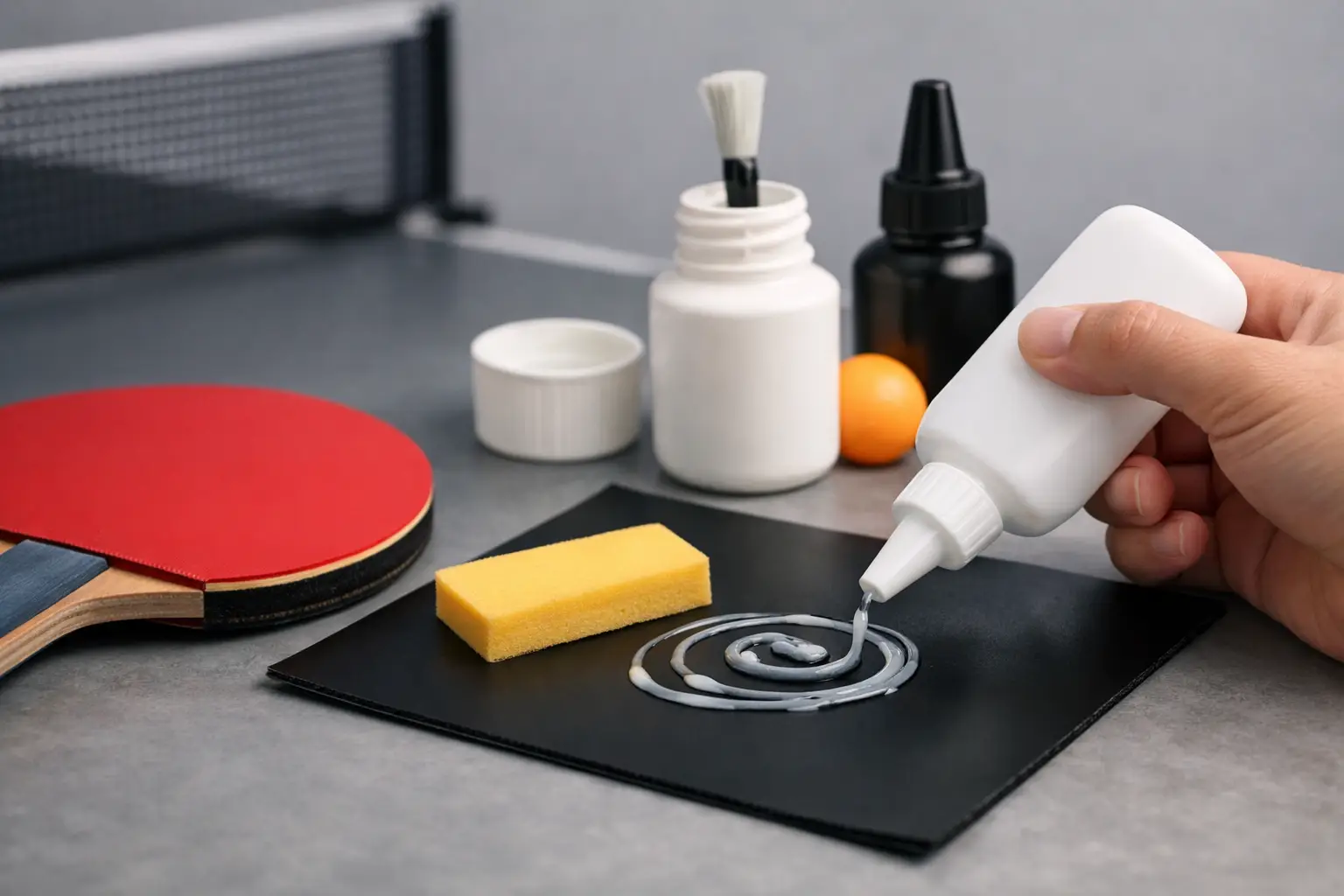
A bad gluing job can make a premium rubber feel average. Uneven adhesion creates dead spots, edge lift, bubbling, and a blade face that never feels quite right on contact. So if you want to know how to select table tennis glue, think beyond the bottle label. The best choice is the one that matches your setup, your maintenance habits, and the way you actually build rackets.
What matters most when you select table tennis glue
For modern table tennis, the baseline choice is simple: use a water-based, VOC-free glue. That keeps you within current competition standards and avoids the strong solvent smell and rule issues linked to older speed glue types. For nearly every club player, league player, junior, and coach, this is the correct category to shop.
Once you are in that category, the real differences show up in viscosity, drying behavior, tack level, and removal. Some glues are thin and fast. They spread quickly, dry in around 8-15 minutes per layer, and are ideal if you re-glue often. Others are thicker and more forgiving, which helps newer players avoid streaks or missed areas, but they can take 15-25 minutes to dry depending on room temperature and how heavily you apply them.
Bond strength matters too, but not in the way many players assume. You do not need the strongest possible adhesive for every setup. A very aggressive bond can be useful for hard-hitting players using firmer offensive rubbers on stiff blades, especially if edge lift has been an issue. But if you change rubbers every few weeks, strong adhesion can make sponge cleanup slower and increase the risk of tearing old glue layers unevenly.
The three player profiles that should guide your choice
If you change rubbers frequently, prioritize clean peel and predictable drying. This is the classic EJ profile, but it also applies to coaches and active competitors who test multiple sheets. A glue with medium bond strength and easy rub-off residue is usually the best fit.
If you build a racket and leave it alone for months, lean more toward stable adhesion and edge security. You want a glue that holds up through repeated sessions, bag pressure, and temperature changes without the rubber corners lifting.
If you are new to racket assembly, look for control in application rather than pure performance language. The easiest glues to work with are usually medium thickness, white when wet, transparent when dry, and forgiving if your sponge or blade sealing is not perfect.
How rubber type changes the right glue choice
Not every sponge behaves the same. Softer sponges often absorb glue differently than hard, dense, high-tension sponges. Thin, porous, or delicate sponges can also be less forgiving during removal.
A useful rule is this: the softer and more porous the sponge, the more value there is in a glue that forms an even film and peels off in one piece later. This reduces cleanup time and lowers the chance of sponge damage. Harder, compact sponges tend to tolerate a wider range of glues and may benefit from slightly stronger bonding if you use powerful strokes and put stress on the topsheet-blade connection.
Pimple-out rubbers are another case where clean, even application matters. Because these sheets are often thinner overall, any inconsistency in the glue layer can be felt more clearly. Defensive players using long pips or anti-spin usually do not need extreme bond strength, but they do need reliability across the full blade face.
Technical glue spec guide
Use this table to compare the characteristics that actually affect setup quality.
| Spec | Low Range | Mid Range | High Range | Best For | |—|—:|—:|—:|—| | Viscosity | 1-2/5 | 3/5 | 4-5/5 | Thin for fast spreading, medium for all-around use, thick for easier control | | Dry time per layer | 5-8 min | 10-15 min | 15-25 min | Fast setup vs more forgiving application | | Bond strength | 2/5 | 3/5 | 4-5/5 | Frequent changes vs long-term attachment | | Peel cleanup | Moderate | Good | Excellent | Important for players who replace rubbers often | | Odor level | Very low | Very low | Low | Water-based competition-safe adhesives | | Typical layers on sponge | 1 | 1-2 | 2 | Hard sponges may need more than soft sponges | | Typical layer on blade | 1 | 1 | 1-2 | More only if blade surface is absorbent |
The sweet spot for most players is easy to spot: medium viscosity, 10-15 minute drying time, medium bond strength, and strong peel cleanup. That combination covers the widest range of offensive and all-around setups.
How to select table tennis glue by use case
If your priority is speed and convenience, choose a glue that brushes out thinly and becomes transparent quickly. This is ideal for tournament prep, club work, and quick rubber replacement. Just know that very fast-drying glues can punish sloppy application. If you miss an area, you may feel it later.
If your priority is the cleanest possible installation, a slightly thicker water-based glue can be the better option. It gives you more visual feedback while spreading and helps create a uniform film. This is especially useful on larger modern offensive blades or when mounting expensive high-end rubbers you do not want to rework.
If your priority is durability, look for a glue known for stable edge hold over time. That matters for players who keep the same sheets on the blade for 8-16 weeks or longer. The trade-off is that removal may take a little more patience.
First-hand testing log: what we look for in a good glue
When we assess a table tennis glue, we look at the process, not just the final bond. On a standard offensive blade with a 2.0 mm high-tension inverted rubber, the useful checkpoints are straightforward.
The glue should spread without clumping in under 60-90 seconds per side. A single blade layer and one to two sponge layers should dry clear in roughly 10-20 minutes in normal indoor conditions around 68-73 F. Once mounted, the sheet should roll down cleanly with no trapped air and no need to pull back large sections for correction.
After 24 hours, the edges should remain flat with no visible lift. On removal, the dried adhesive should peel or rub off in manageable sections rather than turning into dust or tearing into tiny fragments. If a glue fails one of those stages, it is harder to recommend, no matter how premium the packaging looks.
Common mistakes players make
The biggest mistake is choosing glue based only on brand familiarity. Good table tennis brands can still offer glues with different personalities, and the one that works for your teammate may be wrong for your sponge, blade seal, or re-gluing frequency.
The next mistake is applying too much. More glue does not automatically create more speed, more spin, or a better bond. Usually it just increases drying time and cleanup. In most cases, one thin blade coat and one thin sponge coat is enough, with a second sponge coat only when the sponge is especially porous or the first coat absorbs unevenly.
Another common issue is ignoring the blade surface. An unsealed, absorbent wood surface may drink in glue more than expected, while a sealed blade often needs less. That changes how the adhesive behaves and can affect both bond quality and removal.
FAQs
Do I need a special glue for table tennis rubbers?
Yes. General craft adhesives and hardware glues are a bad idea. Use a table tennis-specific, water-based, VOC-free glue made for sponge-to-blade bonding.
What is the best glue for beginners?
Usually a medium-thickness water-based glue with visible white wet film, moderate drying time, and easy cleanup. It is easier to spread evenly and less stressful to work with.
How many layers of glue should I use?
For most setups, one layer on the blade and one layer on the sponge works. Add a second sponge layer if the sponge is porous or the first coat absorbs too quickly.
Does glue affect racket performance?
Yes, but mostly through consistency and contact quality. A clean, even bond preserves the rubber’s intended feel. Poor gluing can create bubbles, uneven rebound, and edge problems.
Can I use the same glue for inverted, short pips, and long pips?
Usually yes, as long as it is a proper water-based table tennis glue. The difference is less about legality and more about how evenly and cleanly it applies to the specific sponge.
The best glue is the one that disappears from your thinking once the racket is built. If it goes on clean, holds through hard sessions, and comes off without drama when it is time for a new sheet, you chose well.