
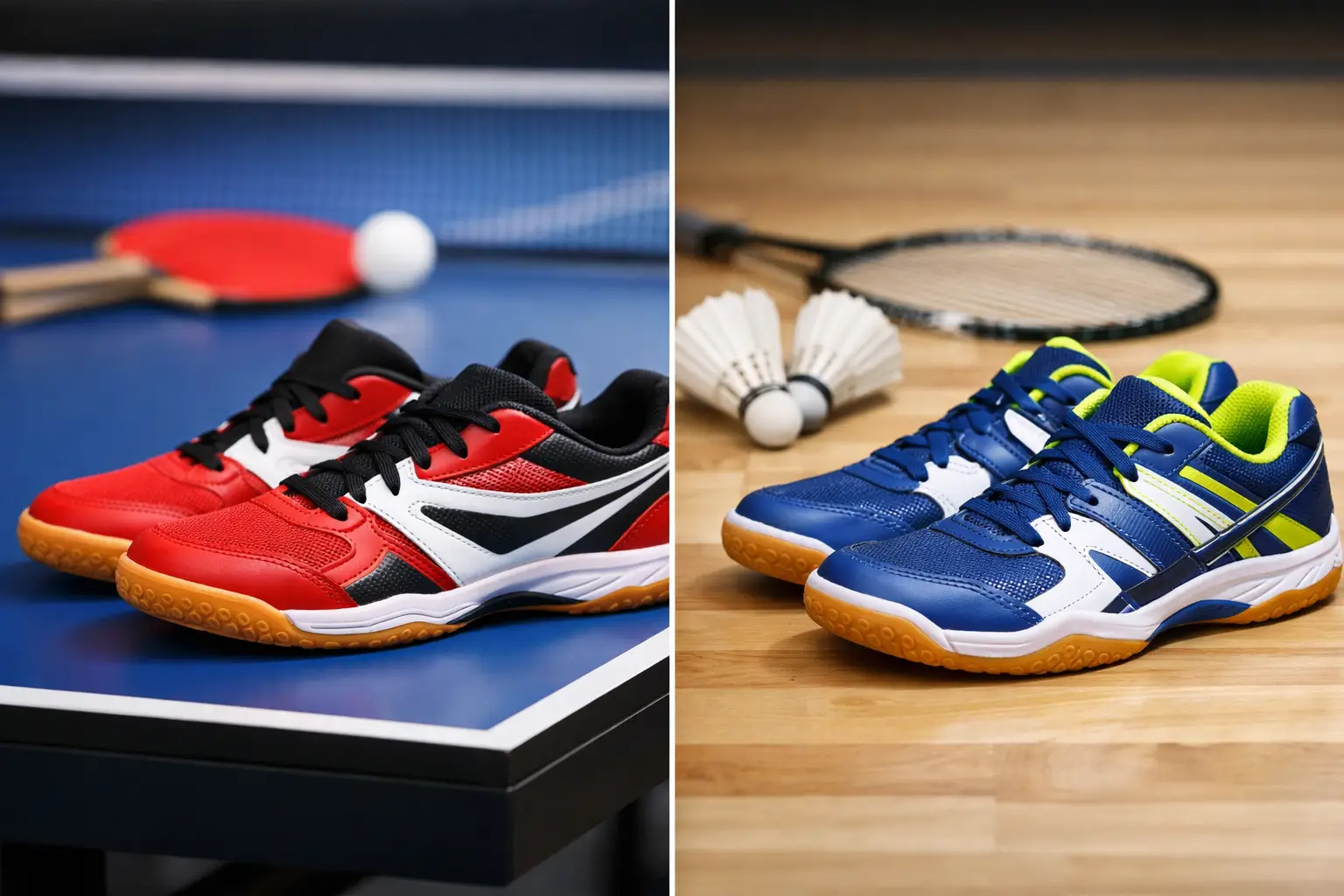
If you have ever tried a fast table tennis session in badminton shoes – or stepped onto a badminton court in table tennis shoes – you felt the difference within a few rallies.
- Table tennis shoes are typically lighter, lower to the floor, and built for micro-adjustments, quick recovery steps, and direct court feel.
- Badminton shoes usually add more cushioning, more side support, and stronger shock absorption for repeated jumps and bigger court coverage.
- Grip patterns can look similar, but traction behavior, upper structure, heel build, and torsional support are tuned for different movement demands.
- You can sometimes use one for the other recreationally, but competitive players usually perform better and move safer in sport-specific footwear.
The question of table tennis shoes vs badminton shoes matters more than many players think. Both are indoor court shoes, both often use non-marking gum rubber outsoles, and both prioritize lateral movement. But once you look at movement patterns, contact time, and impact load, the design differences become clear.
Table tennis shoes vs badminton shoes at a glance
For serious players, the split is simple. Table tennis footwear is optimized for low center-of-gravity movement, short explosive pushes, and constant forefoot readiness close to the table. Badminton footwear is built for a larger court, more vertical loading, deeper lunges, and heavier braking forces.
Here is the quick comparison.
| Spec area | Table tennis shoes | Badminton shoes | |—|—|—| | Typical weight | About 8.5-11.5 oz per shoe | About 10-13.5 oz per shoe | | Stack height | Lower | Moderate | | Court feel | High | Medium | | Cushioning level | Low to medium | Medium to high | | Shock absorption | Moderate | High | | Lateral support | Moderate | High | | Heel structure | Usually compact | Usually more reinforced | | Best for | Fast shuffle, pivot, recovery | Lunges, jumps, wider coverage |
Those numbers vary by brand and size, but the pattern stays consistent. The lighter, flatter profile that feels excellent in table tennis can feel underbuilt for badminton. The extra cushioning and structure that helps on a badminton court can feel slightly high and less precise at the table.
Why the movement pattern changes the shoe
A table tennis point is full of tiny adjustments. Split step, side shuffle, short crossover, quick pivot, recover, repeat. Even when rallies are explosive, the distances are short. Most players want a shoe that keeps them connected to the floor and lets them transfer force immediately without feeling like they are standing on foam.
Badminton is different. The court is larger, the lunges are longer, and the vertical component is much higher. You decelerate hard, push off aggressively, and often absorb impact after jumps or deep reaches. That creates a bigger demand for heel cushioning, midsole compression management, and sidewall support.
This is the core of table tennis shoes vs badminton shoes. One sport rewards directness and speed close to the floor. The other asks for more protection under repeated impact and more structure during larger directional changes.
Sole design and traction behavior
At first glance, both categories often use gum rubber and fine tread patterns for indoor grip. That can make them look interchangeable. In play, traction is more nuanced.
Table tennis shoes tend to prioritize immediate bite on clean indoor floors while staying flexible enough for fast forefoot transitions. Many models feel very agile because the sole is thinner and bends naturally through the front of the foot. That flexibility helps with quick in-and-out footwork and subtle angle changes.
Badminton shoes often combine strong grip with a more substantial chassis. The outsole may feel slightly stiffer, especially through the midfoot, because the shoe has to control harder lateral loads and more aggressive push-offs. On a badminton court, that stability is useful. At the table, some players experience it as less nimble.
There is a trade-off here. More structure can mean more confidence under heavy side load. Less structure can mean faster foot feel and cleaner responsiveness.
Cushioning, impact, and court feel
Cushioning is where the categories separate quickly.
Most table tennis shoes use low-profile midsoles with controlled cushioning rather than plush cushioning. The goal is not maximum softness. It is efficient energy transfer, stable landings, and excellent court feel. A shoe that sits too high can slow weight transfer and make short reactive movements feel delayed.
Badminton shoes usually increase shock absorption in the heel and forefoot. That is not marketing fluff – it reflects the sport. Repeated jumps, lunges, and explosive rear-court movement place more load through the lower body. More cushioning helps reduce harshness and keeps the shoe from bottoming out under impact.
Here is the practical rule. If you are a table tennis player who values instant feedback, a badminton shoe may feel too damped. If you are a badminton player who lands hard or covers a lot of court, a table tennis shoe may feel too minimal.
Support, stability, and upper construction
Upper construction matters just as much as the sole.
Table tennis shoes often use very light mesh or synthetic uppers with just enough reinforcement to keep the foot aligned during shuffles and pivots. The best ones disappear on foot. That is exactly what many offensive players want when they are moving quickly around the backhand corner or stepping in over the table.
Badminton shoes generally add more material around the sidewalls, heel counter, and midfoot. That extra hold helps during hard lateral pushes and stretched defensive movement. On a spec sheet, the difference may not sound dramatic. On court, it often is.
| Support area | Table tennis shoes | Badminton shoes | |—|—|—| | Upper build | Lightweight mesh-synthetic mix | Reinforced mesh-synthetic mix | | Heel counter | Light to moderate | Moderate to firm | | Midfoot torsion control | Moderate | Moderate to high | | Lateral containment | Sport-specific but lighter | More aggressive containment |
If you have a history of ankle instability, badminton shoes can feel more reassuring. If you hate bulky uppers and want maximum freedom for fast table work, table tennis shoes are usually the better match.
Can you use badminton shoes for table tennis?
Yes, sometimes. Plenty of players do, especially at beginner and recreational level.
If the badminton shoe is lightweight, low enough to the ground, and not overly stiff, it can work reasonably well for table tennis. Some players even prefer the extra support, especially if they play farther from the table or have knee sensitivity and want more impact protection.
The downside is precision. Many badminton shoes feel slightly taller, slightly heavier, and slightly less connected during quick table tennis footwork. Those small differences add up when you are trying to recover for the next ball in a fast topspin exchange.
For coaching sessions, multi-ball, or casual club play, crossover use can be fine. For match play, most serious players benefit from a true table tennis model.
Can you use table tennis shoes for badminton?
This is where the compromise gets riskier.
A table tennis shoe may grip well enough for badminton, but the lower cushioning and lighter structure can become a limitation once movement intensity rises. Deep lunges, repeated jumps, and hard lateral braking can expose the shoe’s weaker shock protection and side support.
That does not mean every table tennis shoe fails on a badminton court. A stronger all-around indoor model might survive light use. But if you play badminton regularly or at a decent level, a purpose-built badminton shoe is the safer and more performance-oriented choice.
What serious players should actually buy
If your main sport is table tennis, buy table tennis shoes first. That is the cleanest answer.
Look for a low-profile indoor shoe in the 8.5-11.5 oz range, with strong forefoot flexibility, non-marking rubber, moderate cushioning, and a stable but not bulky upper. For most club players, that setup gives the best mix of speed, grip, and floor feel.
If your main sport is badminton, prioritize badminton shoes with stronger heel cushioning, firmer side support, and enough structure to handle larger court movement. A bit of extra weight is usually worth it because the support demands are higher.
If you play both sports and want one pair, choose the compromise based on your higher-intensity sport. If badminton is the more demanding load on your body, buy badminton shoes. If table tennis is your focus and badminton is occasional, a lighter badminton shoe can be acceptable, but a table tennis model will still feel better at the table.
FAQ: table tennis shoes vs badminton shoes
Are table tennis shoes and badminton shoes the same?
No. Both are indoor court shoes, but table tennis shoes are usually lighter and lower, while badminton shoes add more cushioning and support for bigger movement and impact.
Do table tennis shoes have enough cushioning?
For table tennis, usually yes. They are designed for quick, low-to-the-ground movement rather than repeated jumping. If you want more softness, choose a model with slightly more midsole material, but avoid losing court feel.
Are badminton shoes too heavy for table tennis?
Not always, but many are. A lightweight badminton shoe can work for casual table tennis, though it may still feel less agile than a dedicated table tennis shoe.
Which is better for knee comfort?
Badminton shoes often provide more shock absorption, which some players find better for knee comfort. But for table tennis, too much stack height can reduce movement precision. It depends on your body, your footwork, and your playing level.
What should a club table tennis player prioritize most?
Grip on indoor flooring, low weight, stable lateral movement, and direct court feel. Those four factors usually matter more than maximum cushioning.
The best shoe is the one that matches the demands of your sport, not just the one that looks closest on the shelf. Get that right, and every push-off, recovery step, and wide ball starts to feel cleaner.