
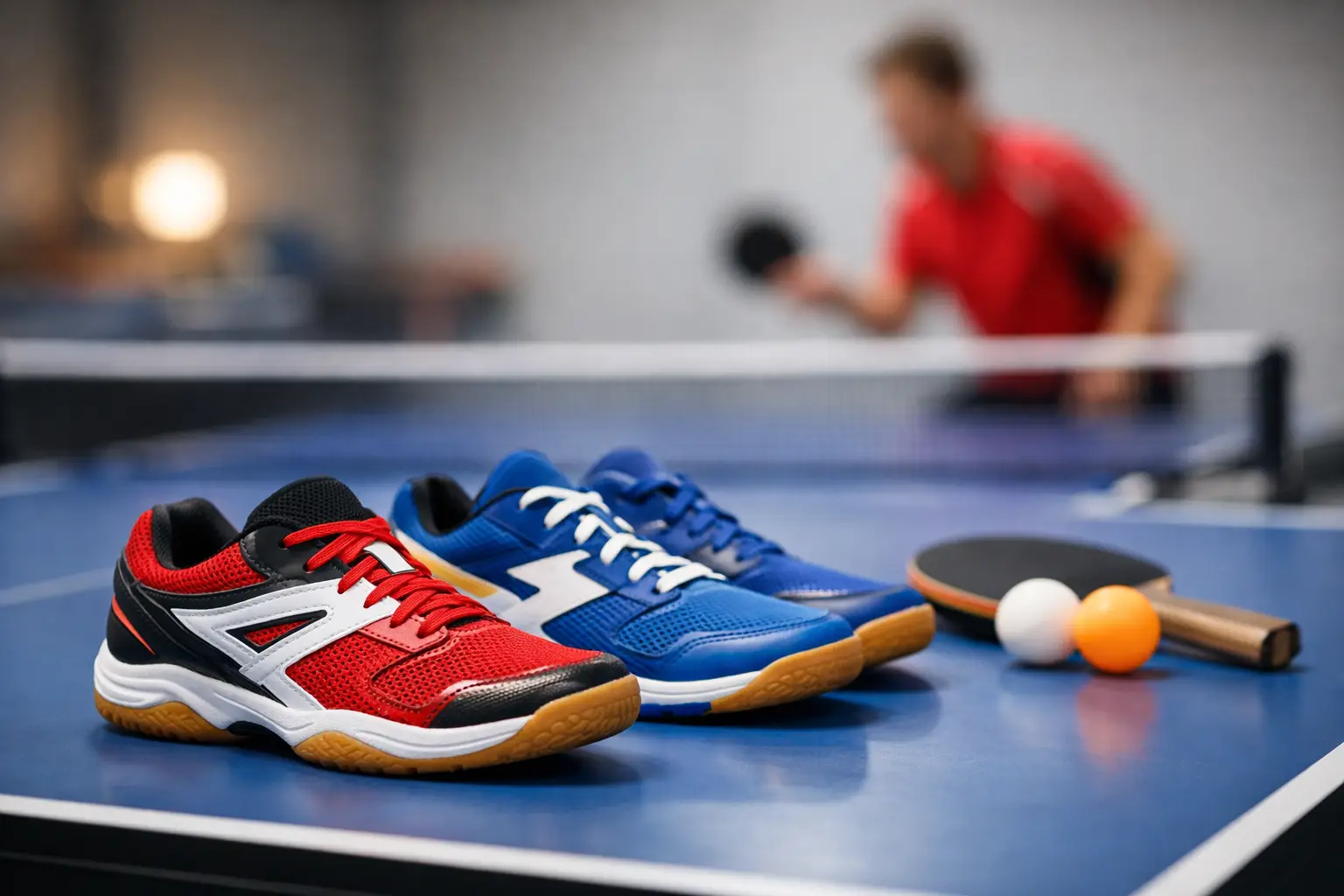
If your first step is late, your recovery is sloppy, or your feet feel cooked after two matches, your shoes are part of the problem. Knowing how to select table tennis shoes is not about picking the lightest pair on the shelf – it is about matching grip, stability, cushioning, and fit to your movement pattern and playing level.
- Prioritize outsole grip, lateral stability, and forefoot flexibility before style.
- Match cushioning to your body weight, training volume, and floor surface.
- A good fit should feel secure at the heel and midfoot, with enough toe room for hard stops.
- Most serious players do better in true indoor court shoes than generic running shoes.
Why shoe choice matters more in table tennis
Table tennis footwork is explosive, repetitive, and brutally directional. You are not moving in long straight lines. You are loading the forefoot, planting wide on lateral steps, braking hard on short balls, then recovering in fractions of a second. That puts very specific demands on footwear.
A shoe that feels fine for casual gym use can fail quickly in table tennis because the sole rolls too much, the heel sits too high, or the upper does not lock the foot in place. The result is not just slower movement. It can mean shin discomfort, hot spots, ankle instability, and a constant feeling that you are chasing balance instead of playing through the ball.
How to select table tennis shoes by key performance specs
The best way to shop is to think in specs, not marketing language. A high-performance table tennis shoe should balance six core areas: weight, grip, cushioning, heel-to-toe profile, upper support, and fit.
1. Grip and outsole pattern
Grip is the first filter. On clean indoor flooring, you want an outsole compound that bites without feeling sticky. Too little traction and your push-off is compromised. Too much tack can make transitions feel abrupt, especially if you use a lot of crossover recovery or wide forehand movement.
Look for a non-marking gum or indoor court outsole with visible flex grooves in the forefoot. In practical terms, most table tennis players do well with outsole hardness around 55-65 Shore A. Softer compounds usually grip better but may wear faster. Harder compounds last longer but can feel less secure on dusty floors.
If your local club floor tends to collect dust, outsole pattern matters as much as rubber compound. A tread that sheds dust better can outperform a softer sole with a flat contact patch.
2. Lateral stability
Table tennis is full of side loading. That means you need a platform that resists collapse when you plant wide. A stable shoe usually has a broad forefoot base, reinforced sidewalls, and a midsole that does not compress too dramatically under pressure.
This is where many lightweight shoes get exposed. They feel fast in the hand, but when you land hard outside your base, they twist or spill over the edge. For aggressive two-winged loopers and modern backhand-dominant players, lateral support is not optional.
3. Cushioning level
Cushioning is not one-size-fits-all. Lighter juniors and quick-footed players often prefer a low-profile setup with direct court feel. Heavier players, coaches doing long multiball sessions, and older athletes usually benefit from more shock absorption.
As a rough guide, forefoot stack around 10-14 mm with moderate-density foam works well for many club players. Too much softness can make your base feel vague. Too little can punish knees and calves during long sessions. The trade-off is simple: more cushioning usually improves comfort, while less cushioning often improves responsiveness.
4. Weight and speed feel
Most table tennis shoes land somewhere around 8.5-12.5 oz per shoe in a men’s US size 9. Lightweight models feel sharp and quick, but shaving grams should never come at the cost of support. If you train three to five times per week, durability and structure usually matter more than an ultra-light spec.
Fast feet come from clean mechanics and confidence in the platform. A shoe that is 1 oz heavier but far more stable can easily feel quicker in real match play.
5. Fit shape and lockdown
Fit is where many players get it wrong. You want a snug heel and midfoot, plus enough room in the toe box to avoid jamming during abrupt stops. A fit that is too long delays directional changes. A fit that is too narrow can create pressure points and numbness.
For most players, ideal extra toe room is around 0.3-0.5 inches in front of the longest toe. The upper should hold the foot securely when you cut laterally without forcing your toes to claw the insole.
6. Flexibility in the forefoot
Table tennis movement depends on efficient toe-off. A stiff forefoot can make you feel flat and delayed. Too much flexibility, though, can reduce support during repeated pushes.
A good table tennis shoe bends at the ball of the foot, not through the arch. That gives you better acceleration while keeping the platform controlled.
Technical spec ranges that actually help when shopping
If you compare serious indoor court models, these are the numbers worth paying attention to.
| Spec | Recommended range for most players | Why it matters | | — | — | — | | Weight | 8.5-12.5 oz per shoe | Lighter feels quicker, heavier often adds support | | Outsole hardness | 55-65 Shore A | Balances grip and durability | | Forefoot stack | 10-14 mm | Helps mix court feel with impact protection | | Heel-to-toe drop | 4-8 mm | Supports quick stance changes without feeling too raised | | Toe room | 0.3-0.5 in | Reduces toe jamming on sudden stops | | Midsole firmness | Medium to medium-firm | Improves stability during lateral movement |
These are not absolute rules, but they are useful benchmarks when product descriptions get vague.
Match the shoe to your playing style
The right shoe for a close-to-the-table blocker is not always the right one for a powerful mid-distance looper. Playing style changes what matters most.
Close-to-table attackers and punch blockers
If your game is built on quick timing, backhand pressure, and short explosive adjustments, prioritize low weight, fast forefoot flex, and direct court feel. You still need grip and support, but too much cushioning can make your base feel muted.
Two-winged loopers
This group needs the most balanced package. You are loading hard on wide forehands, recovering aggressively, and often playing from different distances. Stability and grip should lead the decision, with moderate cushioning close behind.
Defenders and distance movers
If you cover more court and spend longer in rallies, comfort becomes more important. Extra cushioning and durable outsoles matter, especially on harder floors. A slightly more substantial shoe can be the better long-session option.
Juniors and developing players
For juniors, avoid overbuilt shoes that feel clumsy. Keep the profile stable and light, but do not chase minimalist designs if movement mechanics are still developing. A secure fit and predictable grip are more valuable than pro-style cosmetics.
Common mistakes when selecting table tennis shoes
The biggest mistake is buying running shoes. Running shoes are made for forward motion and heel-to-toe transition. Table tennis is about lateral braking, fast redirection, and a low stable base. The higher stack and softer sidewalls of many running shoes can feel unstable the moment you push wide.
Another common mistake is choosing by brand alone. Strong table tennis and indoor court brands often produce excellent shoes, but fit can vary a lot between models. One may run narrow with a firmer sole, while another feels wider and more cushioned.
Players also underestimate floor surface. A shoe that feels amazing on a clean competition court may feel average in a dusty club hall. If your normal venue has less-than-perfect traction, give extra value to outsole design and compound.
A simple buyer comparison table
Use this as a practical filter when narrowing your shortlist.
| Player need | Best shoe profile | Watch out for | | — | — | — | | Maximum quickness | Lightweight, low-profile, flexible forefoot | Reduced durability or support | | Best all-around match play | Medium weight, strong lateral support, balanced cushioning | None if fit is right | | Long coaching sessions | Moderate cushioning, durable upper, stable heel | Too much bulk | | Heavier player | Firmer platform, better shock absorption, wider base | Overly soft midsoles | | Narrow foot | Structured upper, snug heel counter | Excess toe box volume | | Wide foot | Roomier forefoot, adaptable upper materials | Midfoot pressure points |
FAQ
Can I use badminton or volleyball shoes for table tennis?
Yes, often you can. Indoor court shoes from badminton and volleyball can work very well if they have strong grip, low-to-moderate stack height, and solid lateral support. The key is performance profile, not just category label.
Should table tennis shoes be tight or roomy?
They should feel secure, not cramped. Heel slip is a bad sign, but so is toe compression. You want a locked-in heel, stable midfoot, and a little space in front of the toes for braking.
How long do table tennis shoes usually last?
For club players training two to four times weekly, six to twelve months is a common range. Heavy draggers, coaches, and high-volume players can wear through grip or upper support faster.
Do expensive table tennis shoes make a real difference?
Sometimes, yes – but only if the added cost brings better materials, fit, support, or durability. Price alone does not guarantee better movement. The right model for your foot and style matters more than the top price tier.
What should I check first when trying on a pair?
Start with heel lockdown and lateral security. Then test forefoot flex and toe room. If the shoe shifts when you simulate a side step, move on.
A strong shoe will not fix poor footwork, but the wrong one can absolutely hold it back. If you shop with a clear view of grip, support, cushioning, and fit, you will end up with footwear that helps your movement instead of fighting it.