
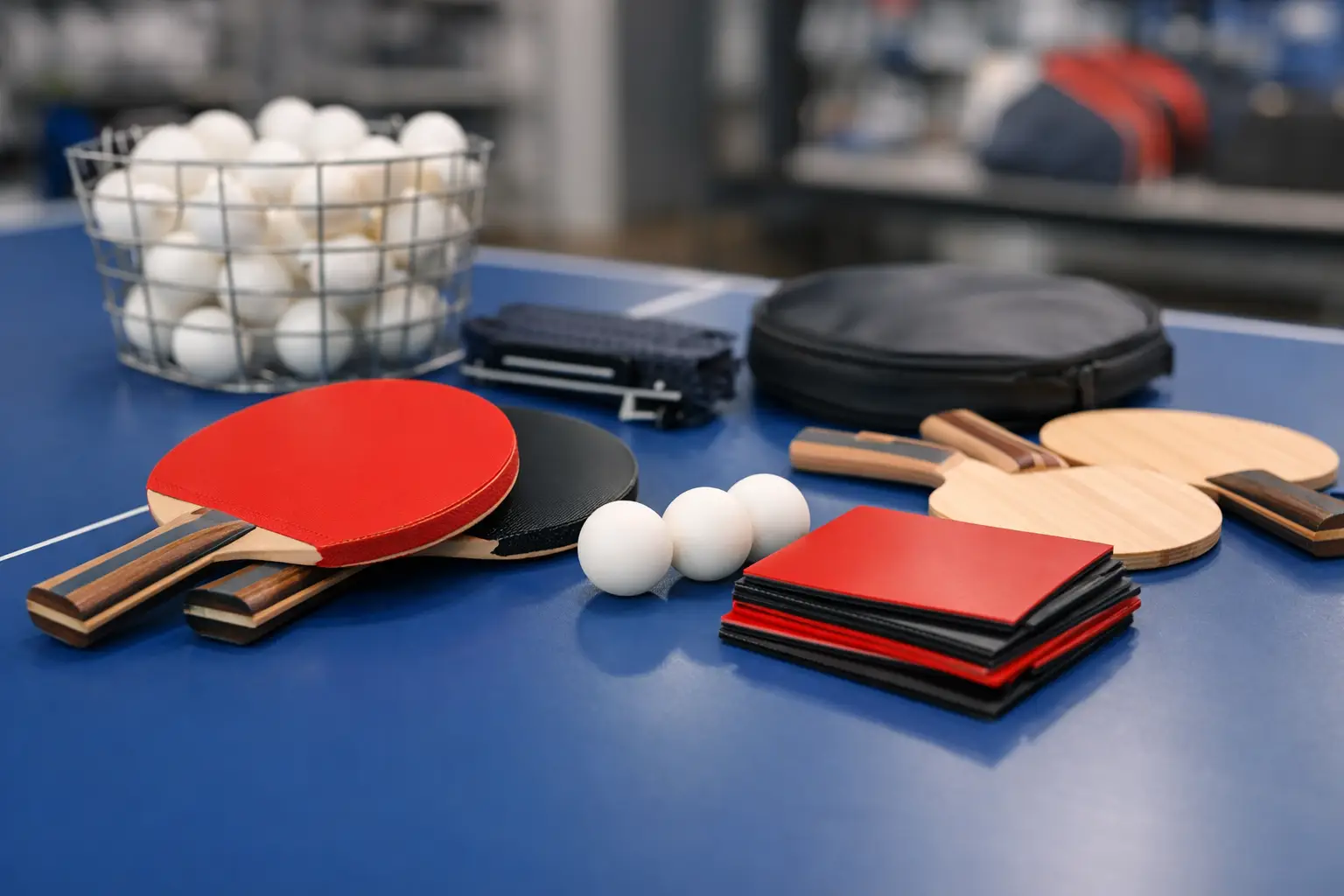
If a discounted blade looks tempting but the flex is wrong for your stroke, it is not a bargain. If a rubber is 30% off but too hard for your contact quality, it can slow your progress. Good table tennis sale equipment is not just cheaper gear – it is the right gear at a better number.
- The best sale buys are usually consumables, proven blade-rubber combinations, training balls, and prior-generation shoes.
- Specs matter more than discount size. Sponge hardness, blade weight, throw angle, and ball quality decide value.
- Sale sections are strongest when you shop by playing style, not by brand alone.
- The smartest buyers use discounts to upgrade intentionally, not to experiment blindly.
How to shop table tennis sale equipment like a serious player
The strongest sale purchases usually come from categories where performance is already well understood. A club player replacing a familiar 47.5-degree tensor rubber is in a much better position than someone randomly buying a carbon blade because the markdown looks big. Sale shopping rewards clarity.
Start with your current setup. If you already know your blade weight range, preferred sponge hardness, and whether you need a higher or lower arc, you can quickly spot real value. If you do not know those basics, the sale section can become expensive because one wrong choice leads to a second purchase.
For most players, the safest high-value categories are rubbers, 3-star balls, shoes, net sets, glues, cleaners, and robot accessories. These are easier to match to need. Blades can also be excellent sale targets, but only when you understand composition, speed class, and dwell profile.
Where the best value usually sits
Not every discount category performs the same. Some products age well in inventory. Others do not.
Rubbers are often the strongest place to start because many advanced players already know what works for them. If you use a medium-hard offensive rubber in the 45 to 50 degree range, buying a prior-package version or outgoing color on sale can be a clean win. The performance trade-off is usually minimal when the rubber is factory-sealed and current enough in design.
Blades are more nuanced. A sale on a high-end outer carbon blade can be excellent if you already play direct, early-timing topspin and want a crisp rebound. It can be a poor buy if you still need more dwell and feedback in the short game. The same logic applies to inner carbon, 7-ply wood, and flexible 5-ply offensive blades. Discount does not change fit.
Shoes are another category where prior-generation models often carry strong value. Midsole geometry, grip pattern, and upper support matter more than whether the colorway is current. If the fit is known and the platform suits table movement, a sale model can outperform a full-price fashion release.
Training products deserve more attention than they usually get. Multi-ball balls, return boards, and robots do not create touch by themselves, but they can increase quality repetitions dramatically. For coaches, clubs, and ambitious home users, sale-priced training gear can deliver better cost per session than almost any blade upgrade.
Comparison table for common table tennis sale equipment
This table gives a practical buying lens rather than pushing one type of product for everyone.
| Category | Typical Spec Range | Best For | Main Risk on Sale | Value Level | |—|—|—|—|—| | Offensive rubber | 42.5 to 50 degrees, 2.0 to max sponge | Loopers, two-wing attackers | Too hard or too bouncy for level | High | | Allround blade | 80 to 88 g, 5-ply wood | Developing players, control-first setups | Too slow for future progression | High | | Carbon blade | 85 to 92 g, inner or outer carbon | Aggressive topspin and countering | Overbuying speed | Medium | | 3-star balls | 40+ ABS, box or bulk pack | Match play, serve practice | Brand consistency variation | Very high | | Table tennis shoes | 250 to 340 g per shoe | Footwork, league play, coaching | Sizing and fit mismatch | High | | Robot | 20 to 120 balls capacity, spin and frequency controls | Solo training | Buying features you will not use | Medium to high | | Glue and cleaner | VOC-free adhesive, standard cleaner volume | Regular maintenance | Low savings if bought singly | Medium |
Blades on sale – when to buy and when to wait
A blade sale gets attention because the ticket price is higher, but that does not automatically make it the best value. Blades are long-term equipment. A good blade might stay in the bag for years, which means fit matters more than discount depth.
If you are choosing between a flexible 5-ply wood blade and an outer carbon blade, ask how you actually win points. If you rely on spin variation, opening loops, and touch over the table, the 5-ply option often gives more dwell and a longer learning runway. If you are strong in backhand counters and take the ball early, outer carbon may convert better.
Blade spec table
| Blade Type | Typical Weight | Feel | Speed Level | Best Player Profile | |—|—|—|—|—| | 5-ply allwood offensive | 82 to 88 g | Flexible to medium | OFF- to OFF | Spin-oriented allround attacker | | 7-ply allwood | 86 to 92 g | Solid, direct | OFF | Hitter or flatter topspin player | | Inner carbon | 84 to 91 g | Softer carbon feel | OFF to OFF+ | Advanced looper seeking dwell | | Outer carbon | 85 to 92 g | Crisp, fast rebound | OFF+ | Early-timing aggressive attacker |
A practical rule: buy a sale blade only if you can describe your preferred feel in one sentence. If you cannot, sale rubbers or balls are usually the safer play.
Rubbers are often the smartest sale purchase
Rubber is where many players gain or lose the most. It is also where sale shopping can be very efficient, especially if you are replacing the same sheet or moving one step softer or harder within a familiar family.
For offensive players, sponge hardness matters immediately. Around 42.5 to 45 degrees tends to suit improving club players who want easier engagement and more forgiveness. Around 47.5 to 50 degrees often fits stronger mechanics, better compression, and more direct power transfer. Topsheet grip and arc matter just as much. A lower-throw rubber can feel fast and clean in counters but demanding on slow openings. A higher-throw rubber can improve net clearance but feel less precise in punch exchanges.
Rubber spec table
| Rubber Type | Sponge Hardness | Throw Angle | Speed | Control | Best Use | |—|—|—|—|—|—| | Medium tensor | 42.5 to 45 | Medium-high | High | Good | Developing offensive play | | Medium-hard tensor | 47.5 | Medium | High to very high | Medium-good | Balanced two-wing attack | | Hard hybrid | 50 to 53 | Medium-high | High with full stroke | Medium | Spin-first forehand play | | Classic control rubber | 38 to 42 | Medium | Medium | High | Allround and placement play |
First-hand testing log: on a 5-ply offensive wood blade around 85 g, medium-hard tensors in the 47.5-degree class usually give the best balance for league-level topspin. They are firm enough for counterplay but still accessible in the short game. Harder hybrid sheets reward stronger acceleration, especially on forehand, but they ask more from technique and physical timing.
Balls, shoes, and training gear can beat flashy discounts
Many players overfocus on blades because blades feel exciting. Yet some of the best sale purchases are less glamorous.
A bulk pack of quality ABS 3-star balls improves serve work, receive repetitions, and multi-ball efficiency. The benefit is immediate and measurable. If you train three times per week, saving on match-quality balls can produce more actual development than changing to a blade that is 5% faster.
Shoes matter even more than they get credit for. Stable lateral support, strong grip on dusty floors, and a responsive but not overly thick midsole all affect recovery time between shots. A sale shoe from a proven table tennis line can be a smarter upgrade than a premium racket component, especially if your current pair slips or collapses under load.
Robots are a bigger decision, but sale pricing can change the math. If you train alone often, adjustable frequency, placement variation, and spin programming matter more than maximum ball capacity. Coaches and clubs should value durability, ease of refill, and repeatability. Home users often overspend on advanced programming they rarely use.
What experienced buyers check before committing
Serious players do not just read the discount percentage. They check compatibility. That means blade-rubber weight balance, whether a rubber suits forehand or backhand, how a shoe fits relative to foot width, and whether a robot matches actual training habits.
They also think in replacement cycles. Rubber is a recurring cost. Balls and glue are recurring costs. Shoes wear out. A sale is strongest when it lowers the cost of products you will definitely need again. This is why established lines from Butterfly, DHS, XIOM, Yasaka, JOOLA, Andro, DONIC, TIBHAR, VICTAS, Stiga, Nittaku, and Mizuno often make sense in outlet sections. Known performance reduces purchase risk.
FAQ about table tennis sale equipment
Is sale equipment lower quality?
Not necessarily. In specialist retail, sale products are often prior-generation models, outgoing packaging, seasonal colorways, or overstocked lines. The key is product fit, not the reason for the markdown.
Should I buy a faster blade if it is heavily discounted?
Only if your current level supports it. A faster blade can reduce control in serve receive, blocking, and opening spin. A cheaper price does not reduce the adaptation cost.
What is the safest category to buy on sale?
For most players, rubbers, match balls, shoes they already know fit, glue, cleaners, and training accessories are the safest categories. They carry less setup risk than a completely new blade profile.
Are older rubber generations still worth buying?
Often yes, especially if the sheet is sealed and from a respected performance line. Many outgoing offensive rubbers still offer excellent speed-spin balance for club and league play.
How do I know if a sale item is really good value?
Compare the spec to your current setup, not just the original price. The right hardness, weight, feel, and use case matter more than the percentage off.
The best sale purchase is usually the one that lets you train and compete with more confidence next week, not the one that looked most impressive on the product page.