
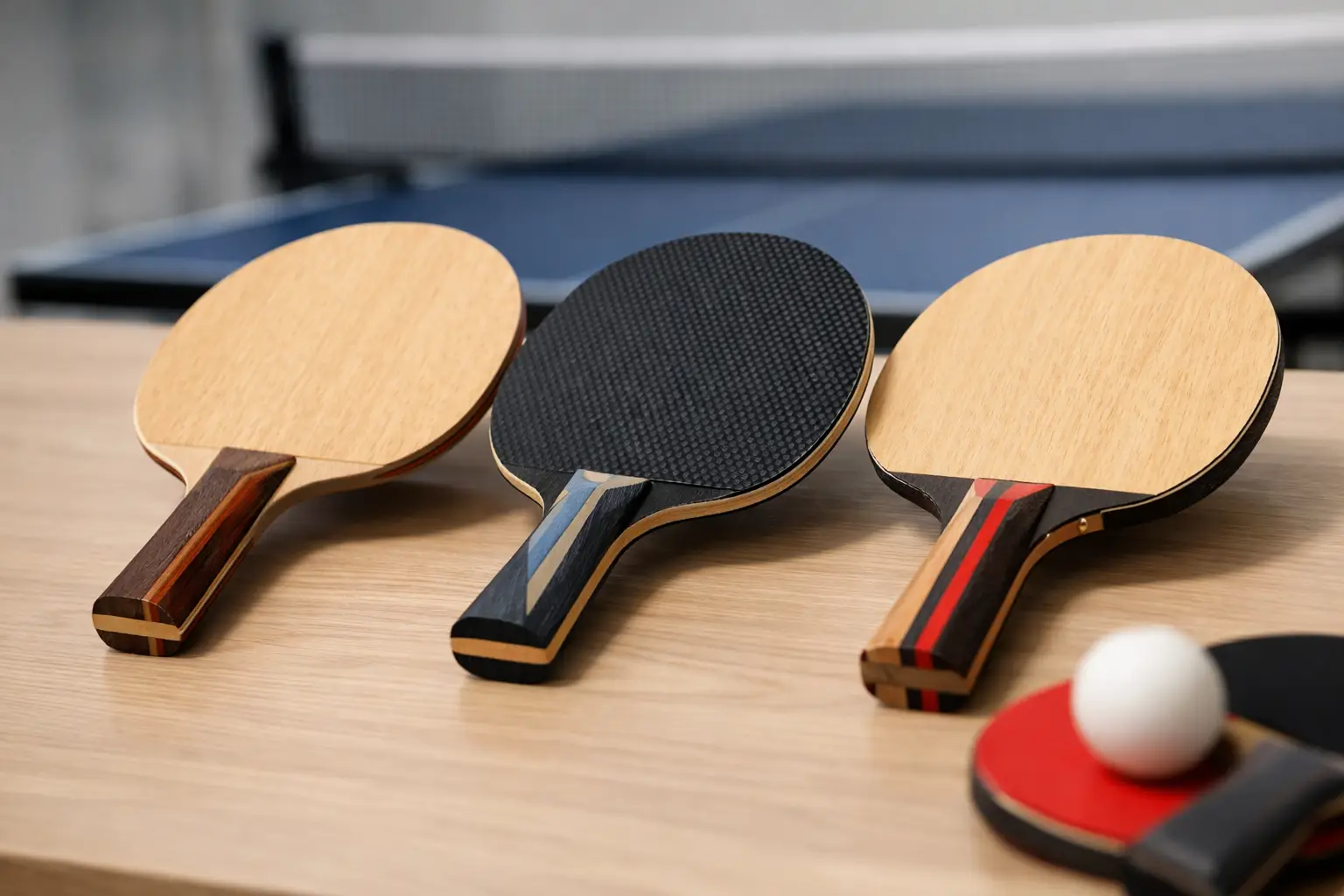
If your shots feel either too wild or too dead, the problem is often the blade, not your technique alone.
- Blade construction changes speed, dwell time, vibration, and throw more than many players expect.
- The main categories are allwood, outer carbon, inner carbon, composite control blades, and defensive blades.
- Weight, ply structure, head size, and flex all matter just as much as the brand name on the handle.
- The right choice depends on how you win points – early timing, heavy spin, punch blocking, counterlooping, or pure control.
A good table tennis blade types guide should do one thing clearly: help you stop guessing. Serious players often spend more time comparing rubbers than blades, but the blade is the core of the racket. It dictates the feel in the hand, the rebound at contact, and how forgiving the setup becomes when timing is not perfect. If you are upgrading from a premade racket or replacing an aging favorite, getting the blade type right is the fastest way to build a setup that actually matches your game.
Table tennis blade types guide: start with construction
Most blades sit between 5 and 7 plies, with some composite layers added for extra rebound or stability. Typical weight runs from about 80 to 95 grams for standard offensive blades, while defensive heads can go larger and heavier. Thickness usually falls in the 5.5 to 7.0 mm range. Those numbers are not cosmetic. A 5.7 mm limba-ayous 5-ply allwood blade will usually feel very different from a 6.0 mm outer carbon blade at the same listed speed.
The easiest way to separate blade types is by material and where any composite layer sits in the construction. That affects dwell time, sweet spot size, stiffness, and how direct the ball leaves the racket.
Allwood blades
Allwood blades are still the safest recommendation for most developing club players and a lot of advanced spin players as well. The classic structure is 5-ply wood, often built with limba outer plies for grip and feel, ayous core for elasticity, or koto for a crisper response. Typical speed range is ALL+ to OFF, average weight is around 82 to 90 grams, and the feel is usually more connected with clearer feedback into the hand.
That feedback matters. On serves, open-ups, and slow loops, allwood blades usually provide longer dwell time and easier arc creation. They also make short game touch more intuitive. If you are learning to loop with quality rather than just force, a flexible 5-ply allwood blade is hard to beat.
The trade-off is top-end power. Against stronger blockers or from mid-distance, some allwood blades can feel underpowered compared with modern composites. A stiffer 7-ply allwood option can solve part of that problem. These blades usually sit around OFF to OFF+, with weights around 86 to 95 grams, and they favor flatter hitters, punch blockers, and direct backhand play.
Technical spec table: allwood blades
| Blade type | Common build | Typical weight | Typical thickness | Speed feel | Control feel | Best for | |—|—|—:|—:|—|—|—| | 5-ply allwood | Limba-ayous-limba variants | 82-90 g | 5.5-6.0 mm | ALL+ to OFF | High | Loopers, allround attackers, developing players | | 7-ply allwood | Harder, stiffer wood stack | 86-95 g | 6.0-6.7 mm | OFF to OFF+ | Medium-high | Hitters, blockers, close-to-table attackers |
Outer carbon blades
Outer carbon blades place the composite layer directly under the top ply. That makes them feel faster, harder, and more immediate on contact. Common materials include ALC, ZLC, Super ZLC, arylate-carbon, and other carbon hybrids. Typical weight sits around 85 to 92 grams, thickness around 5.7 to 6.2 mm, and the sweet spot is larger than most allwood constructions.
This is the blade type many ambitious players want first, but not always the one they should buy first. Outer carbon is excellent for aggressive backhand counters, active blocks, and fast topspin exchanges near the table. The rebound is cleaner and more direct, especially when contacting the ball early. If your game is built around pressure, pace, and taking time away, this category makes sense.
The downside is reduced margin in touch play and opening against backspin unless your hand skills are already solid. A lot of players move to outer carbon too early, then wonder why their short game gets jumpy and their opening loop loses shape.
Technical spec table: outer carbon blades
| Blade type | Common build | Typical weight | Typical thickness | Speed feel | Control feel | Best for | |—|——:|—:|—|—|—| | Outer carbon | Koto-carbon-ayous core variants | 85-92 g | 5.7-6.2 mm | OFF+ to OFF++ | Medium | Counterloopers, blockers, fast attackers | | Outer ALC style | Softer carbon composite | 85-90 g | 5.7-6.0 mm | OFF+ | Medium-high | Balanced offensive players wanting speed with some dwell |
Inner carbon and innerfiber blades
Inner carbon blades place the composite layer closer to the core. That one design change softens the first impact, increases dwell compared with outer carbon, and keeps some of the big sweet spot and reserve power that offensive players want. Typical speed is OFF to OFF+, average weight is 84 to 91 grams, and they often suit the modern two-winged looper better than very stiff outer constructions.
For many competitive players, this is the sweet spot category. You get easier opening spin, better ball hold in the short game, and enough stability for hard countering when the rally speeds up. On paper, inner carbon can look only slightly different from outer carbon. In play, the feel is usually more elastic and more forgiving.
If you loop heavy from both sides or play a spin-first game with occasional power from mid-distance, innerfiber designs are often the better long-term choice. They reward full strokes without becoming too demanding in service receive.
Technical spec table: inner carbon blades
| Blade type | Common build | Typical weight | Typical thickness | Speed feel | Control feel | Best for | |—|—|—:|—:|—|—|—| | Inner carbon | Limba-wood-carbon-core variants | 84-91 g | 5.8-6.2 mm | OFF to OFF+ | High for composite | Spin attackers, two-wing loopers | | Inner ALC style | Softer arylate-carbon inside | 85-90 g | 5.7-6.1 mm | OFF | High | Controlled offense, opening loops, varied topspin |
Composite control blades and specialty fibers
Not every composite blade is a rocket. Some use softer fibers, thinner constructions, or allround-oriented layups to add stability without making the blade brutally fast. These are useful for players who like the enlarged sweet spot of composites but still prioritize consistency. Typical speed range is ALL+ to OFF-, weight often 80 to 88 grams.
These blades work well for compact strokes, controlled topspin, and players stepping up from classic allwood into something a little more stable. They also make sense for older players or coaches who value forgiveness over pure pace.
Technical spec table: composite control blades
| Blade type | Common build | Typical weight | Typical thickness | Speed feel | Control feel | Best for | |—|—|—:|—:|—|—|—| | Control composite | Soft fiber + wood | 80-88 g | 5.5-6.0 mm | ALL+ to OFF- | Very high | Allround players, controlled attackers | | Thin carbon control | Reduced thickness composite | 82-89 g | 5.4-5.9 mm | OFF- | High | Players wanting sweet spot without excess speed |
Defensive blades
Defensive blades usually have larger head sizes, softer feel, and slower rebound. Standard weight can range from 85 to 100 grams, but balance varies because of the oversized head. Thickness is often lower, around 5.0 to 5.8 mm, though there are faster modern defense blades built for chopping and counterattacking.
A pure defensive blade helps with chop depth, control on heavy incoming spin, and variation. The larger face gives more reach and can increase dwell time. But if you mostly block at the table and only occasionally back away, a classic defensive blade may feel too slow in attack. Modern defenders often choose faster defensive or allround-plus blades so they can still finish points.
Technical spec table: defensive blades
| Blade type | Common build | Typical weight | Typical thickness | Speed feel | Control feel | Best for | |—|—|—:|—:|—|—|—| | Classic defense | Oversized soft 5-ply wood | 85-100 g | 5.0-5.8 mm | DEF to ALL | Very high | Choppers, variation defenders | | Modern defense | Faster oversized wood or composite | 86-95 g | 5.5-6.2 mm | ALL to OFF- | High | Defenders who counterattack |
How to choose the right blade type
Start with your rally pattern, not your ambition. If most of your points begin with serve, receive, opening loop, and controlled topspin, an allwood 5-ply or inner carbon blade is usually the right zone. If you win through early timing, backhand pressure, and direct counters, 7-ply allwood or outer carbon deserves a closer look.
Then check your usual contact quality. Players who consistently hit the ball in front and generate their own acceleration can handle stiffer, faster blades. Players whose timing drifts under pressure usually benefit from more dwell and more feedback. That is not a downgrade. It is a smarter performance match.
Weight is another filter serious buyers should not ignore. Under 84 grams often feels easier in fast wrist exchanges and service play. Around 86 to 90 grams is the broad offensive sweet spot. Above 92 grams can add punch and stability, but only if your hand and forearm are comfortable over long sessions. A blade that feels great for twenty minutes can become work by match four.
Handle shape matters too. Flared handles suit most players, straight handles help those who twiddle or adjust grip a lot, and anatomic shapes can feel locked-in but less flexible. Small detail, real effect.
Common mistakes players make
The biggest mistake is buying for peak speed instead of usable speed. A blade that is 10 percent too fast can cost far more points in serve receive, opening quality, and passive control than it gains on winners.
The second mistake is ignoring blade-rubber interaction. A hard tensor or tacky hybrid on an outer carbon blade can become excellent in expert hands and demanding in average club hands. The same rubber on inner carbon or quality allwood often becomes more playable.
The third mistake is assuming pro usage should dictate your setup. Elite players have timing, footwork, and touch that let them exploit very fast constructions. Most league players need a blade that helps them produce quality under pressure, not one that looks impressive in a spec sheet.
FAQ
Which blade type is best for beginners moving into club play?
A 5-ply allwood blade in the ALL+ to OFF- range is still the best starting point for most improving players. It teaches touch, spin creation, and stroke quality without hiding mistakes.
Is inner carbon better than outer carbon?
It depends on your game. Inner carbon is usually easier for spin, touch, and controlled offense. Outer carbon is usually better for direct speed, blocking stability, and early-timing attack.
Are 7-ply wood blades faster than 5-ply wood blades?
Usually, yes. They are generally stiffer and more direct, with stronger rebound on flatter attacks. They can feel less flexible on heavy opening loops.
How much should blade weight matter?
A lot. Even 3 to 5 grams changes balance, swing speed, and comfort. Competitive players should treat weight as a core spec, not a minor detail.
The best blade is not the one with the loudest reputation. It is the one that makes your strongest patterns repeatable when the score gets tight, and that is always the setup worth building around.