
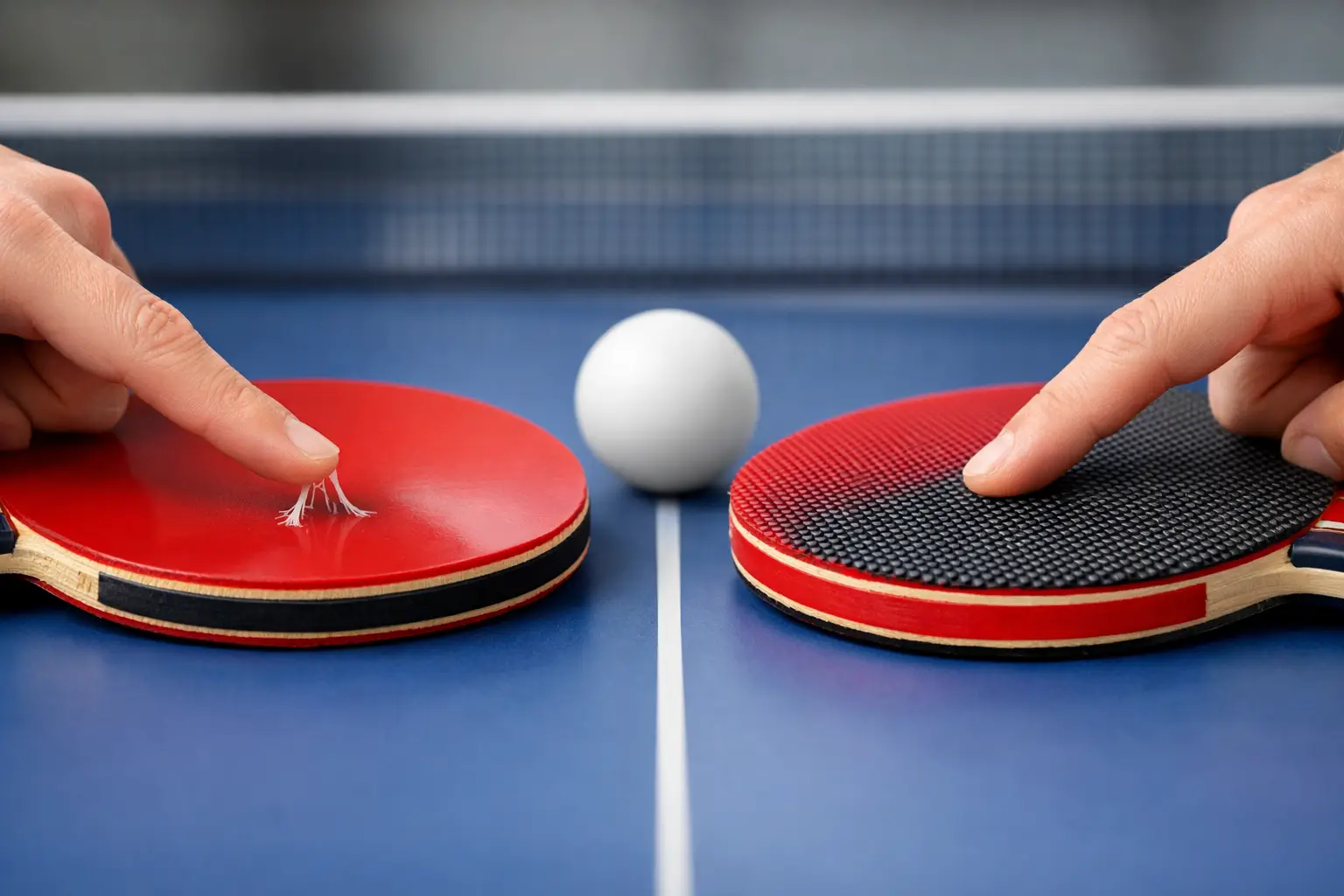
Quick take:
- Sticky vs grippy table tennis rubber is really a question of top sheet friction, contact time, and how much of the spin comes from tackiness versus sponge rebound.
- Sticky rubbers usually reward full strokes, heavier brushing, and short-game control. Grippy rubbers usually feel easier for topspin exchanges, counters, and modern backhand play.
- Hardness, weight, and blade pairing matter as much as the top sheet type. A hard sticky rubber on a fast carbon blade plays very differently from a medium grippy rubber on limba outer wood.
- If you are between the two, choose based on your match pattern, not your favorite pro highlight reel.
A lot of players ask about sticky vs grippy table tennis rubber after one very specific moment – they borrow a teammate’s racket, loop one ball, and suddenly everything feels different. The arc changes. The short game changes. Your opening loop either bites harder or shoots longer than expected. That is not placebo. The top sheet type changes how the ball interacts with the rubber from serve receive to full-power rallying.
Sticky vs grippy table tennis rubber: what changes on the table?
The simplest distinction is this: sticky rubbers have a tacky top sheet that can physically hold the ball for a split second, while grippy rubbers rely on high friction without that adhesive feel. Both can generate heavy spin, but they do it differently.
Sticky rubber tends to grab the ball more on thin brush contact. That helps on serves, pushes, and slow opening loops, especially against backspin. Grippy rubber usually feels cleaner and more elastic on impact, which helps when you engage the sponge in topspin rallies, counters, and over-the-table attacks.
For serious players, the difference is not just spin quantity. It is spin access. Sticky topsheets often ask for better acceleration and timing. Grippy topsheets usually give more spin with less perfect technique, especially when the rally speeds up.
How sticky rubber plays
A classic sticky setup is associated with Chinese-style offensive play, especially on the forehand. The top sheet is tacky, the sponge is often firmer, and the rubber rewards a committed stroke. On serves, a sticky rubber can produce very loaded spin because the topsheet bites the ball aggressively at low speed. In the short game, that same bite can make touch play feel precise and compact.
On loops against backspin, sticky rubber often gives excellent confidence if your contact is active. The throw can be lower, the arc can be very direct, and the first opening can feel extremely dangerous when the technique is there. Flat hits and power drives can also feel solid because the harder sponge keeps the ball from bottoming out.
The trade-off is that sticky rubber can feel slower on passive shots. If you block lazily or counter with a short stroke, the ball may not come off as easily. That is why many players love tacky forehands but avoid tacky backhands.
Typical sticky rubber specs
| Characteristic | Common range | On-table effect | |—|—:|—| | Top sheet feel | Tacky | More bite on serves, pushes, slow loops | | Sponge hardness | 37-41 deg Chinese scale, about 50-55 deg ESN equivalent | Stable on power shots, less free rebound | | Cut weight | 48-54 g | Heavier racket feel, stronger ball at full swing | | Throw angle | Low to medium | Direct trajectory, strong forward penetration | | Catapult | Low to medium | More linear response, better short-game control |
How grippy rubber plays
Grippy rubbers are the default choice for many modern attacking players, especially in Europe and for backhand-focused two-wing loopers. The top sheet is not tacky in the traditional sense, but it has strong friction and is usually paired with a more elastic sponge. That creates easier rebound and more automatic pace.
In topspin exchanges, grippy rubber often feels more forgiving. You do not need to work as hard to clear the net with quality rotation. Counterlooping is easier. Backhand flicks and punchy topspins feel faster and more natural. On passive blocks, there is usually more built-in pace.
The trade-off is in the short game. Because the rubber is more lively, touch can require softer hands and better racket angle control. Very spin-sensitive grippy rubbers can also react more strongly to incoming spin on serve receive.
Typical grippy rubber specs
| Characteristic | Common range | On-table effect | |—|—:|—| | Top sheet feel | High-friction, non-tacky | Easy spin with sponge engagement | | Sponge hardness | 42.5-50 deg ESN scale | Wider range from balanced to very fast | | Cut weight | 43-50 g | Often slightly lighter than tacky options | | Throw angle | Medium to high | Easier net clearance in topspin rallies | | Catapult | Medium to high | More pace on blocks, counters, and compact strokes |
The real comparison: spin, speed, control, and forgiveness
If you compare sticky vs grippy table tennis rubber only by asking which one spins more, you miss the important part. At low impact, sticky rubber often wins because it can generate heavy spin on serve, push, and slow brush contact. At medium to high impact, a grippy tensor-style rubber can produce massive spin too, often with more arc and easier depth.
Speed usually favors grippy rubber, especially in stock form. Many modern grippy rubbers have stronger catapult and require less effort to create pressure. Sticky rubber can still be very fast in advanced hands, but the speed is more player-generated.
Control depends on the shot. Sticky rubber often gives better short-game control and a more predictable linear response. Grippy rubber often gives better rally control because it is easier to lift, counter, and recover in topspin exchanges.
Forgiveness usually favors grippy rubber. For many club players, it is simply easier to use over a whole match, especially on the backhand side.
Which players usually benefit from sticky rubber?
Sticky rubber makes the most sense for aggressive forehand players who like to build points with serve, receive, and the first opening loop. It also suits players who prefer a direct ball, a firmer impact, and a more deliberate stroke. If you are strong through the legs and waist and you like to accelerate through the ball, sticky rubber can feel incredibly connected.
It is also a strong fit for players who think tactically in the short game. Heavy serve variation, loaded pushes, and opening first are all areas where tacky topsheets can offer real match value.
That said, not every player needs the hardest, tackiest sheet available. Some hybrid rubbers now combine light tack with more elastic sponge behavior, giving a middle ground that is easier for league players to manage.
Which players usually benefit from grippy rubber?
Grippy rubber is often the better fit for players who attack from both wings, rely on quick transitions, or want easier access to pace and spin without huge stroke mechanics. If your backhand is active, if you counter close to the table, or if you play a lot of topspin-to-topspin, grippy rubber usually feels more natural.
It is also the safer recommendation for developing juniors and improving intermediates. The higher catapult and easier arc help players execute modern offensive strokes without demanding perfect contact every time.
For many setups, the practical answer is mixed. Sticky or hybrid on the forehand, grippy on the backhand. That pairing is common because it reflects how most players use each wing.
First-hand testing log: what players usually notice in one session
In testing across offensive 5-ply wood and inner carbon blades, the most obvious difference shows up in three drills. In short push exchanges, sticky rubber keeps the ball shorter with less bounce and a slightly lower trajectory. In multiball opening against backspin, tacky sheets produce a more loaded first ball when the stroke is full, but punish lazy acceleration. In backhand counter drills, grippy rubbers are quicker to adapt to and easier to repeat at match tempo.
Weight also shows up fast. A tacky forehand rubber that cuts at 52 g versus a grippy option at 46 g changes racket balance enough to matter, especially for wristy backhand players. Hardness matters too. A 39-degree Chinese sponge can feel firmer and less springy than a 47.5-degree ESN sponge because the scales and rebound behavior are different.
Blade pairing matters more than most players think
A sticky rubber on a soft outer limba blade can feel much more forgiving than the same rubber on a stiff outer carbon blade. The dwell from the blade helps the topsheet work. On the grippy side, a high-catapult rubber on a fast carbon blade can become too jumpy in the short game for players below advanced league level.
As a rule, hard sticky rubber often pairs well with blades that add some dwell or flex, while very lively grippy rubber often benefits from a blade that keeps the response stable. This is where specialist equipment selection matters more than chasing a single headline spec.
So which should you buy?
If your game is built around serve quality, heavy forehand initiation, and confident touch over the table, sticky rubber is a serious option. If you want easier topspin, more pace on compact strokes, and a backhand that feels active right away, grippy rubber is usually the better call.
If you are still unsure, do not frame it as a permanent identity. Rubber choice is not a philosophy test. It is a performance decision based on stroke length, contact quality, blade pairing, and what wins you points on league night.
FAQ
Is sticky rubber always slower than grippy rubber?
Not always. It often feels slower on passive shots because there is less built-in catapult, but at full acceleration it can be very fast and heavy.
Can beginners use sticky table tennis rubber?
They can, but many beginners and lower intermediates find grippy rubber easier because it gives more rebound and easier topspin with less effort.
Why do so many players use sticky forehand and grippy backhand?
Because the forehand often uses longer, stronger strokes that suit tacky rubbers, while the backhand benefits from quicker rebound and easier countering.
Are hybrid rubbers a good compromise?
Yes. Hybrid rubbers are often the best bridge for players who want some tacky bite with more modern catapult and easier rally play.
The best rubber is the one that supports your actual match patterns. Choose the sheet that makes your first attack more dangerous, your short game more reliable, and your second ball easier to trust.