
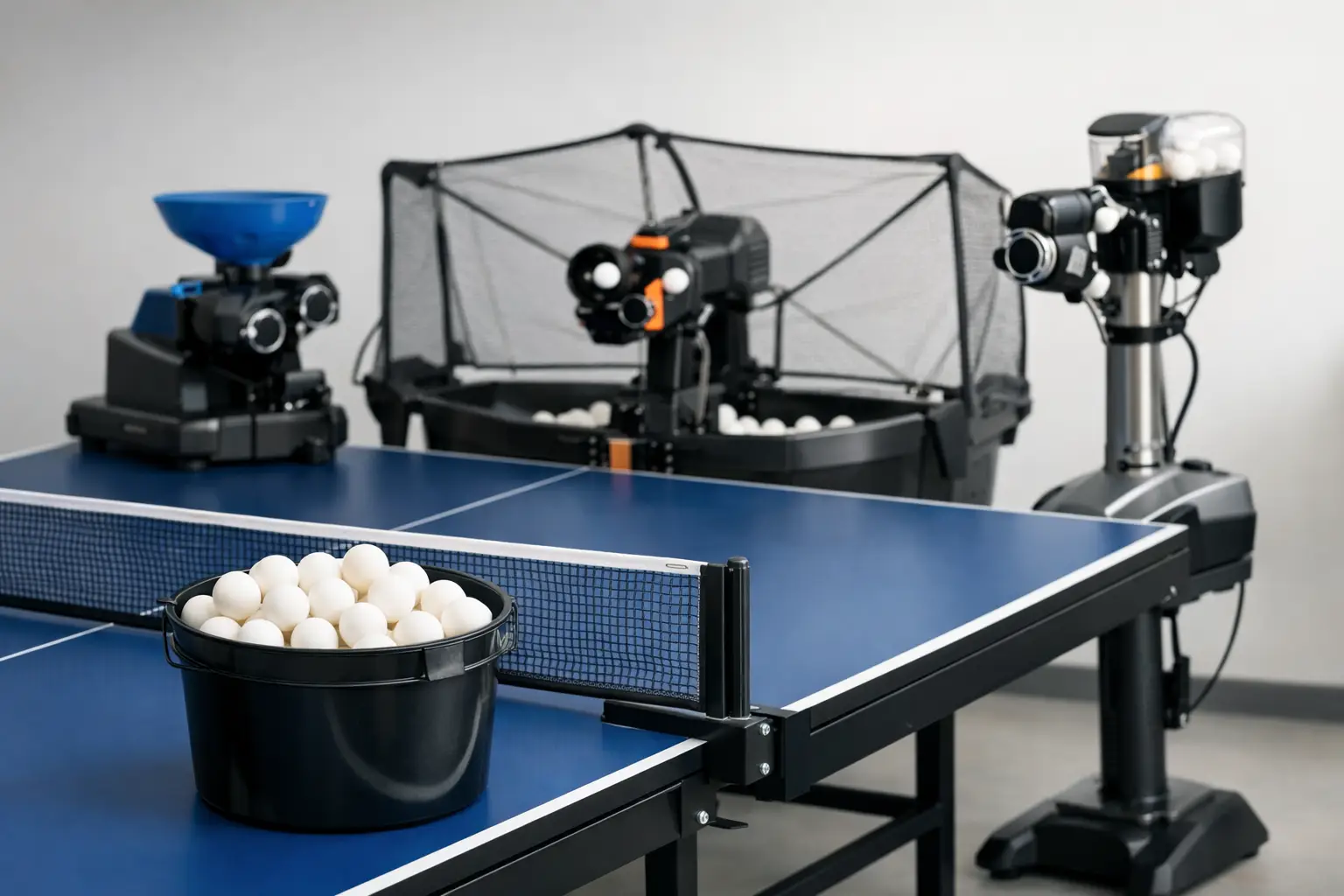
Need a robot that actually improves your training instead of just feeding easy balls? This table tennis robot comparison focuses on what serious players care about most – spin quality, ball frequency, placement range, programming depth, and real training value.
- Entry-level robots are fine for repetition, but they usually limit spin variation and realistic sequencing.
- Mid-range models hit the sweet spot for most club players with better oscillation, frequency control, and remote use.
- High-end robots justify the price when you need drill programming, short-long variation, and coach-like multi-ball patterns.
- The best choice depends less on brand prestige and more on your level, space, and training goals.
A good table tennis robot can expose weaknesses fast. If your backhand breaks down under tempo, your footwork gets late on wide recovery, or your opening loop quality drops after the third ball, a robot makes that obvious in a hurry. That is why any serious table tennis robot comparison has to go beyond marketing claims and look at how each machine feeds under realistic training conditions.
How to read this table tennis robot comparison
Most buyers start with price, but that is usually the wrong first filter. A robot is a training tool, so the real question is what type of session you want to run. There is a big difference between simple rhythm work, random placement training, and programmed serve-plus-third-ball simulation.
For this comparison, the key performance metrics are practical rather than theoretical. Ball frequency matters, but so does whether the machine maintains consistent arc and spin at higher speeds. Oscillation matters, but the quality of placement spread matters more than whether the box says “random.” Ball capacity, recycling system, remote control, and assembly also affect how often you will actually use it.
Comparison table: 5 common robot tiers
| Robot tier | Best for | Balls/min | Spin types | Placement control | Ball capacity | Typical price band | Main trade-off | |—|—|—:|—|—|—:|—|—| | Basic single-wheel | Beginners, repetition drills | 20-70 | Light topspin, light backspin | Fixed or narrow oscillation | 80-120 | $150-$300 | Limited realism | | Advanced single-wheel | Developing club players | 20-90 | Topspin, backspin, some no-spin | Wider oscillation, basic programming | 100-150 | $300-$700 | Spin quality still limited | | Dual-wheel mid-range | League players, juniors, home training | 25-100 | Better topspin/backspin variation | Directional and sequence options | 120-180 | $700-$1,200 | More setup complexity | | Multi-function programmable | Coaches, advanced players | 30-120 | Full spin variation, mixed drills | Precise placement and saved drills | 150-300 | $1,200-$2,000 | Higher cost | | Premium club robot | Intensive training environments | 30-150 | High-spin, realistic transitions | Deep drill design, random logic | 200+ | $2,000+ | Overkill for many homes |
Product-by-product table tennis robot comparison
1. Basic single-wheel robot
This is the budget category many players enter first. It is useful for timing, contact repetition, and basic footwork, especially if you are training alone in a garage or basement.
| Spec | Typical range | |—|—| | Head type | Single wheel | | Ball frequency | 20-70 balls/min | | Speed | 15-45 mph | | Spin adjustment | Light topspin/backspin | | Oscillation | Fixed or 2-point | | Capacity | 80-120 balls | | Power | AC adapter or battery | | Weight | 6-12 lb |
The strength here is simplicity. You can be hitting in minutes, and for forehand repetition or backhand counters that is enough. The weakness is realism. Single-wheel designs often blur speed and spin together, so you do not get the same independent control that stronger players need for short backspin, heavy opening balls, or sudden pace changes.
2. Advanced single-wheel robot
This category improves the training ceiling without jumping into premium pricing. It suits club players who want more than mindless feeding but are not ready to pay for full drill programming.
| Spec | Typical range | |—|—| | Head type | Single wheel, enhanced controls | | Ball frequency | 20-90 balls/min | | Speed | 20-55 mph | | Spin adjustment | Topspin, backspin, light sidespin simulation | | Oscillation | Random and wide-angle | | Capacity | 100-150 balls | | Remote | Wired or basic wireless | | Weight | 8-15 lb |
The big gain is adjustability. Better control panels and remotes make it easier to train transitions such as backhand block to wide forehand loop. Still, the feed can remain a bit mechanical. If you are an advanced looper or coach, you may start feeling those limits quickly.
3. Dual-wheel mid-range robot
For many serious players, this is the value sweet spot. Dual-wheel systems generally separate speed and spin better, which means the ball shape is more believable and the training quality jumps.
| Spec | Typical range | |—|—| | Head type | Dual wheel | | Ball frequency | 25-100 balls/min | | Speed | 20-65 mph | | Spin adjustment | Topspin, backspin, no-spin, mixed settings | | Oscillation | 2-line, random, programmable zones | | Capacity | 120-180 balls | | Remote | Wireless on many models | | Weight | 10-20 lb |
This is where opening-up practice starts to feel useful. You can set heavier backspin, then mix a faster topspin ball without the same compromise in trajectory. For league players working on receive quality, first attack, and recovery patterns, that matters more than fancy marketing terms.
4. Multi-function programmable robot
If you want session structure, not just ball supply, this tier is where things get interesting. These machines are built for players who know what they need to train.
| Spec | Typical range | |—|—| | Head type | Dual wheel or advanced head | | Ball frequency | 30-120 balls/min | | Speed | 25-70 mph | | Spin adjustment | Full spin range with stored drills | | Oscillation | Multi-point exact placement | | Capacity | 150-300 balls | | App/remote | Wireless remote or app control | | Weight | 14-25 lb |
The advantage is drill logic. You can run short backspin to the forehand, long topspin to the backhand, then a wide ball for recovery. That is much closer to actual point construction. The trade-off is that setup takes longer, and if you only want 20 minutes of basic hitting, much of the feature set may go unused.
5. Premium club robot
This is the serious end of the market. It is aimed at coaches, performance centers, and high-volume users who need repeatable, advanced feeds across many sessions.
| Spec | Typical range | |—|—| | Head type | Premium dual or multi-wheel | | Ball frequency | 30-150 balls/min | | Speed | 25-75 mph | | Spin adjustment | Heavy spin, rapid variation, advanced sequencing | | Oscillation | Full-table precision and random logic | | Capacity | 200-300+ balls | | Software | Advanced app or memory bank | | Weight | 18-35 lb |
These robots can be excellent, but they are not automatically the best buy. If your training space is tight, your sessions are short, or you do not use programmed drills, you may be paying for capabilities you will not touch. For clubs, though, durability and throughput can justify the jump.
What matters most when choosing a robot
Spin quality changes everything. A weak backspin feed teaches the wrong opening mechanics because you can get away with lazy contact. Likewise, a topspin feed that lacks kick will flatter your blocking and timing. Stronger players should prioritize independent spin and speed control over extra accessories.
Placement is the next separator. A robot that can only swing left-right in a wide pattern is fine for cardio, but not for technical detail. Better machines let you narrow zones, alternate specific positions, or create short-long variation. That turns random exercise into purposeful training.
Ball capacity sounds minor until you stop every few minutes to reload. For solo training, 120 balls is workable. For intensive footwork or coaching sessions, 200-plus feels much better. Recycling nets also matter more than most buyers expect. If collection is messy, usage drops.
Noise and stability are worth mentioning too. Some robots are loud enough to be annoying in home spaces, and lighter bases can shift during harder feed settings. Those details rarely sell robots, but they absolutely affect day-to-day ownership.
First-hand testing log: what we usually notice fast
Across repeated sessions, the same patterns show up. Entry-level robots are good for grooving contact and warming up, but they often become predictable after a week or two. Mid-range dual-wheel robots usually give the biggest improvement in training quality per dollar because the ball behaves more like a real shot.
Programmable units shine when the player already has a clear plan. Coaches and advanced juniors get real value from sequence training. Recreational buyers often overestimate how much programming they will use, then default to two or three standard drills anyway.
Which robot fits which player?
Beginners and casual improvers should stay realistic. If your main goal is repeating strokes and building confidence, a basic or advanced single-wheel robot can do the job. Spending premium money will not fix technical issues by itself.
Club players around the league level should look hardest at dual-wheel models. This is where spin becomes credible enough for meaningful opening practice, transition work, and movement under pressure. For most serious home users, this is the category to beat.
Coaches, ambitious juniors, and advanced players benefit most from programmable robots. If you want to rehearse patterns rather than just strokes, the extra cost makes sense. At that point, the robot starts acting less like a feeder and more like a structured training partner.
FAQ
Is a table tennis robot worth it for a club player?
Usually yes, if you train alone regularly. The value comes from repetition volume and targeted drills, not from replacing match play or coaching.
What is better, single-wheel or dual-wheel?
Single-wheel is cheaper and simpler. Dual-wheel is usually better for realistic spin, better trajectory control, and more advanced training.
How many balls should a robot hold?
For home solo sessions, 100-150 balls is enough for most players. For longer drills or club use, 200 or more is more practical.
Can a robot improve footwork?
Yes, but only if placement is controlled well. Wide random feeds can build movement, while programmable zones are better for match-relevant footwork patterns.
Should coaches buy premium robots?
If the robot will be used often across multiple players, premium models can make sense. If usage is occasional, a strong mid-range programmable unit is often the smarter buy.
The right robot is the one you will use three times a week, not the one with the longest feature list. Buy for your training level now, with just enough headroom for the next step in your game.